
 English
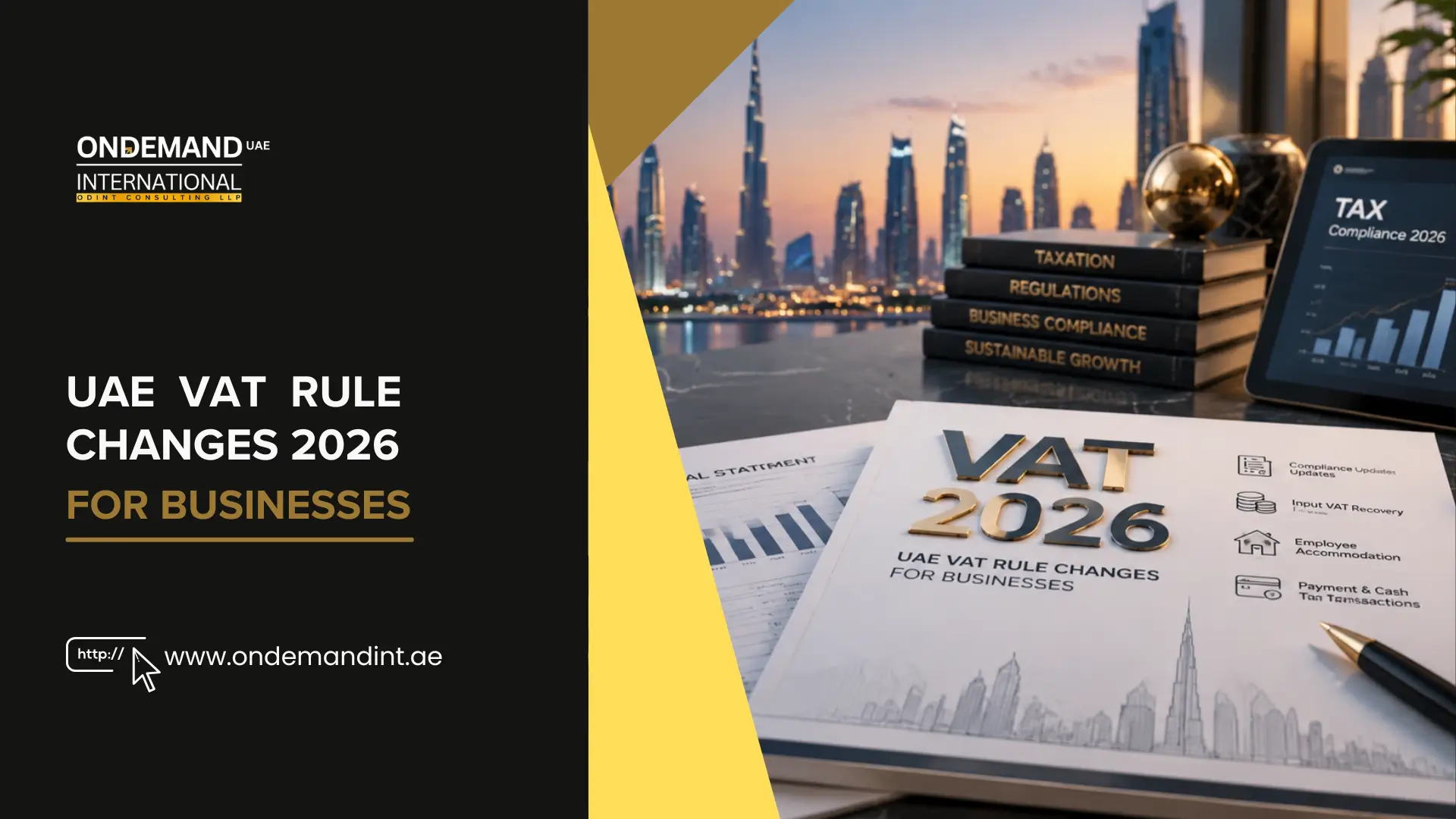
There are several significant changes to the UAE VAT rules in 2026, including changes to input tax recovery, employee accommodation, cash payments, composite supplies, and VAT compliance. The changes add new requirements and clarifications for businesses, but the UAE VAT rate remains 5%.
A major development in 2026 is Cabinet Decision No. 149 of 2026, which brings several updates to the updated VAT regulations. Businesses should also consider the separate Federal Decree-Law No. 16 of 2025, effective from January 1, 2026, which introduced changes to the reverse charge mechanism and related documentation requirements. This guide provides the essential UAE VAT rule changes 2026 for businesses, their effective dates, and what businesses should look at.
Read More: How to Start an Business in UAE?
What Are the UAE VAT Rule Changes 2026 For Businesses?
There are a number of significant changes in UAE VAT provisions for 2026, including new guidance on input tax recovery, employee accommodation, cash payments, composite supplies, and input tax apportionment. These updates mainly affect how businesses calculate and recover VAT, while the standard VAT rate remains 5%.
The recent updated Executive Regulation covers several areas, including:
- Input VAT recovery on employee accommodation
- Input VAT recovery for certain cash payments
- Treatment of single composite supplies
- Input tax apportionment
- Capital Assets Scheme provisions
- VAT treatment of certain medical products
The amendments do not all apply on the same date. Businesses should consider the following timeline:
| Effective Date | Main Change |
|---|---|
| January 1, 2026 | VAT Law amendments, including changes to the reverse charge mechanism and related documentation |
| October 1, 2026 | Executive Regulation changes covering areas such as cash payments, employee accommodation and composite supplies |
| January 1, 2027 | Revised input tax apportionment provisions |
The January 1, 2026 amendments introduced changes to the VAT Law, including adjustments to the reverse charge mechanism. The October 1, 2026 amendments focus on several provisions of the Executive Regulation, while the revised input tax apportionment rules have a later application date.
For businesses, the key point is that the UAE VAT rule changes 2026 for businesses have different effective dates. Companies should therefore review the specific rules that apply to their activities and update their VAT procedures, accounting systems, payment processes, and supporting documentation accordingly.
How Have UAE VAT Rules Changed for Large Cash Payments?
Businesses should pay particular attention to the new rules affecting input VAT recovery when certain payments are made in cash.
Under the amended Executive Regulation, new provisions restrict the recovery of input tax where payments are made in cash and exceed thresholds that will be prescribed through a decision of the Minister of Finance.
This does not mean that businesses are prohibited from making cash payments. Instead, the change concerns whether the VAT paid on certain cash transactions can be recovered as input tax.
For businesses, this makes payment methods and supporting documentation more important. Companies that regularly make high-value cash payments should review their purchasing and payment procedures and monitor the applicable threshold once it is formally prescribed.
Businesses should also avoid relying on an unofficial fixed cash-payment limit until the relevant Ministerial decision is available.
What should businesses review?
Companies can prepare by reviewing:
- High-value cash transactions
- Supplier payment procedures
- VAT documentation
- Accounting-system controls
- Input tax recovery procedures
- Alternative electronic or traceable payment methods
The Ministry of Finance says the cash-payment provision is intended to strengthen compliance and reduce the risk of tax evasion.
What Are the Changes to VAT Recovery on Employee Accommodation?
The 2026 Executive Regulation amendments clarify the VAT treatment of employee accommodation for input tax recovery purposes.
The Ministry of Finance specifically identified employee accommodation as one of the areas clarified by Cabinet Decision No. 149 of 2026.
This change is especially relevant to companies that provide staff accommodation under their employment arrangements.
Rather than assuming that VAT on all employee accommodation costs is automatically recoverable or automatically blocked, businesses should assess the accommodation against the applicable VAT rules and the conditions in the amended Executive Regulation.
Companies providing staff accommodation should therefore review:
- Accommodation arrangements
- Employment-related obligations
- Lease and supplier invoices
- Whether accommodation is provided as part of employment
- Supporting documentation for input VAT claims
The objective of the amendment is to provide greater clarity around when input tax recovery is available.
How Have the Rules Changed for Employee Benefits and Input VAT Recovery?
Employee-related expenses can create VAT questions when businesses provide goods or services to employees as part of their employment arrangements.
The 2026 amendments provide additional clarification around input tax recovery in this area, including provisions related to employee accommodation.
Businesses should distinguish between expenses incurred for genuine business purposes and expenses that may represent personal consumption or benefits outside the conditions for input tax recovery.
For example, businesses should review their policies for:
- Employee accommodation
- Employee-related benefits
- Medical or welfare-related expenses
- Contractual employee benefits
- Supporting invoices and records
The correct VAT treatment depends on the nature of the expense and the specific conditions in UAE VAT legislation. Businesses should therefore avoid applying a blanket rule to every employee-related expense.
Have UAE VAT Rules Changed for Composite Supplies?
Yes. The amended Executive Regulation introduces provisions dealing with the VAT treatment of a single composite supply.
Under the updated rules, the VAT treatment of a single composite supply is determined by considering the overall economic substance of the transaction.
A composite supply can contain multiple components that are supplied together as one overall transaction.
For businesses, the important point is that the VAT treatment should reflect the substance and structure of the transaction rather than automatically treating every individual component as a completely separate supply.
Businesses with bundled products or services should therefore review contracts, invoices and pricing structures to determine whether a transaction falls within the rules for a single composite supply.
This can be particularly relevant to businesses selling packages that combine different goods or services.
How Are UAE VAT Input Tax Apportionment Rules Changing?
The UAE is also changing the methodology used for input tax apportionment.
Input tax apportionment is relevant where a taxable person incurs input VAT relating to both taxable and other activities and cannot directly attribute the full amount of input tax to taxable supplies.
The revised approach is designed to better reflect how a taxable person’s economic activities are structured. The existing apportionment method for government entities and charities continues to apply.
This change can affect businesses that have mixed activities and need to determine the amount of input VAT that can be recovered.
Businesses should therefore review their VAT calculations, accounting classifications and apportionment methodology before the relevant provisions become applicable.
The timing is also important: the revised apportionment provisions have a different application timeline from most of the other amendments introduced by Cabinet Decision No. 149 of 2026.
Is the UAE VAT Rate Changing in 2026?
No. The standard UAE VAT rate remains 5%.
The 2026 amendments do not introduce an increase in the standard VAT rate. Instead, they change or clarify specific rules governing VAT administration, input tax recovery and the treatment of particular transactions.
The Federal Tax Authority continues to identify 5% as the standard UAE VAT rate. Therefore, businesses should not confuse the UAE VAT rule changes 2026 for businesses with a change in the standard VAT rate.
The key issue for businesses is understanding whether the new rules affect how VAT is recovered, calculated or documented, rather than expecting a new general VAT rate.
What Should Businesses Do to Prepare for the 2026 VAT Changes?
Businesses affected by the UAE VAT rule changes 2026 for businesses should review their VAT processes before the applicable amendments take effect.
A practical review can include:
Review cash-payment procedures
Identify high-value cash transactions and assess whether they could be affected by the new input tax recovery restriction once the applicable threshold is prescribed.
Review employee accommodation
Check accommodation arrangements, contracts, invoices and existing input VAT recovery practices.
Review employee-related expenses
Assess employee benefits and related expenses individually rather than assuming that all employee costs have the same VAT treatment.
Review bundled products and services
Identify transactions that may qualify as single composite supplies and review how they are currently treated for VAT purposes.
Review input tax apportionment
Businesses using an apportionment method should assess whether their existing calculations will need to change when the revised methodology becomes applicable.
Update accounting and VAT systems
Tax codes, accounting procedures and internal VAT controls should reflect the applicable amendments and effective dates.
Maintain supporting records
The FTA requires businesses to retain appropriate tax documentation, and the 2026 amendments place continued emphasis on supporting evidence and compliance. The January 2026 VAT Law amendment also requires taxable persons using the reverse charge mechanism to retain supporting transaction documents.
Conclusion
The UAE VAT changes in 2026 are focused mainly on tax administration, input VAT recovery and transaction treatment, rather than increasing the standard VAT rate. The latest amendments under Cabinet Decision No. 149 of 2026 address employee accommodation, cash payments, composite supplies, input tax apportionment and other technical VAT provisions. Most of these changes apply from October 1, 2026, while some provisions have different application dates.
Businesses should review their VAT processes, documentation, payment methods, and input tax recovery procedures before the relevant rules apply. If you need support understanding how the UAE VAT rule changes 2026 for businesses may affect your company, OnDemand International UAE can help you review your requirements and plan the next steps with the right tax and business setup support.
FAQ’s
Is UAE VAT still 5% in 2026?
Yes. The standard UAE VAT rate remains 5%. The 2026 amendments mainly concern specific VAT rules, input tax recovery, and compliance requirements rather than changing the standard VAT rate.
What are the main UAE VAT changes in 2026?
The key changes cover input VAT recovery on certain cash payments, employee accommodation, employee benefits, composite supplies, and input tax apportionment. Separate VAT Law amendments also took effect from January 1, 2026.
When do the UAE VAT changes take effect in 2026?
Most of the latest amendments under Cabinet Decision No. 149 of 2026 apply from October 1, 2026. Some provisions, including changes to input tax apportionment, have different application dates.